
Compliance records for fire departments and AHJs where configured.
Fire departments can use supported inspections, report review, premises, deficiencies, permits, preplans, hydrants, community programs, documents, communications, dashboards, and audit history under a written entitlement and activation plan. Department authority remains with the department.
Guspora is the technology company behind the business: we build focused websites, apps, software, AI, automation, and integrations, and provide one connected Platform for the workflows that run afterward.
Supported department workflows, activated through documented setup requirements.
The written entitlement can cover report intake and review, inspections, community programs, premises, preplans, hydrants, hazardous-material records, permits, deficiencies, documents and signing, communications, dashboards, exports, and audit history without separate software-module fees.
Inspection and compliance
AHJ inspection workflow
Review submissions from contractors with AHJ-side annotation, formal acceptance or rejection, and a calendar of upcoming jurisdictional inspection deadlines.
Community inspections
Schedule, perform, and capture findings for inspections your department runs directly. Code citations under the jurisdiction’s adopted edition. Property Relationship Graph notifies every party with rights.
Violation lifecycle
Track active violations across the jurisdiction by deadline, property, responsible party, and code section. Re-inspection workflow when remediation is reported.
Permitting
Permit applications, plan review, fee assessment, issuance, expiration tracking, certificate of occupancy, and a historical record with the full document trail.
Pre-incident planning
Building information for first responders: hazardous-material inventories, occupant counts for schools and hospitals, contact information for owners and managers, suppression system documentation, water supply, access.
Hydrant management
Hydrant inventory, inspection scheduling, flow testing, maintenance tracking, mapping for first-responder access, water main pressure documentation.
Additional supported operations, subject to setup requirements
Incident reporting
Configured incident-reporting workflows can help organize records for casualty reporting, property loss, cause investigation, review, and submission steps where available.
Shift scheduling
Personnel scheduling for shifts, station assignments, apparatus, mutual aid coverage, vacation and time-off, callback and overtime, certifications per shift, daily roster.
Training LMS
Required training assignment by certification, completion tracking, renewal tracking, continuing-education hours, instructor credentials, training-facility coordination.
Incident command
Real-time incident management, resource tracking, personnel accountability, NIMS-compliant ICS forms, after-action reporting, post-incident review.
Fire investigations
Origin and cause investigation documentation, evidence chain of custody, witness statements, photo documentation, lab analysis tracking, court testimony preparation.
Community connect
Public-facing website integration, community education resource publishing, public safety announcements, smoke detector and child safety seat programs, public records request handling.
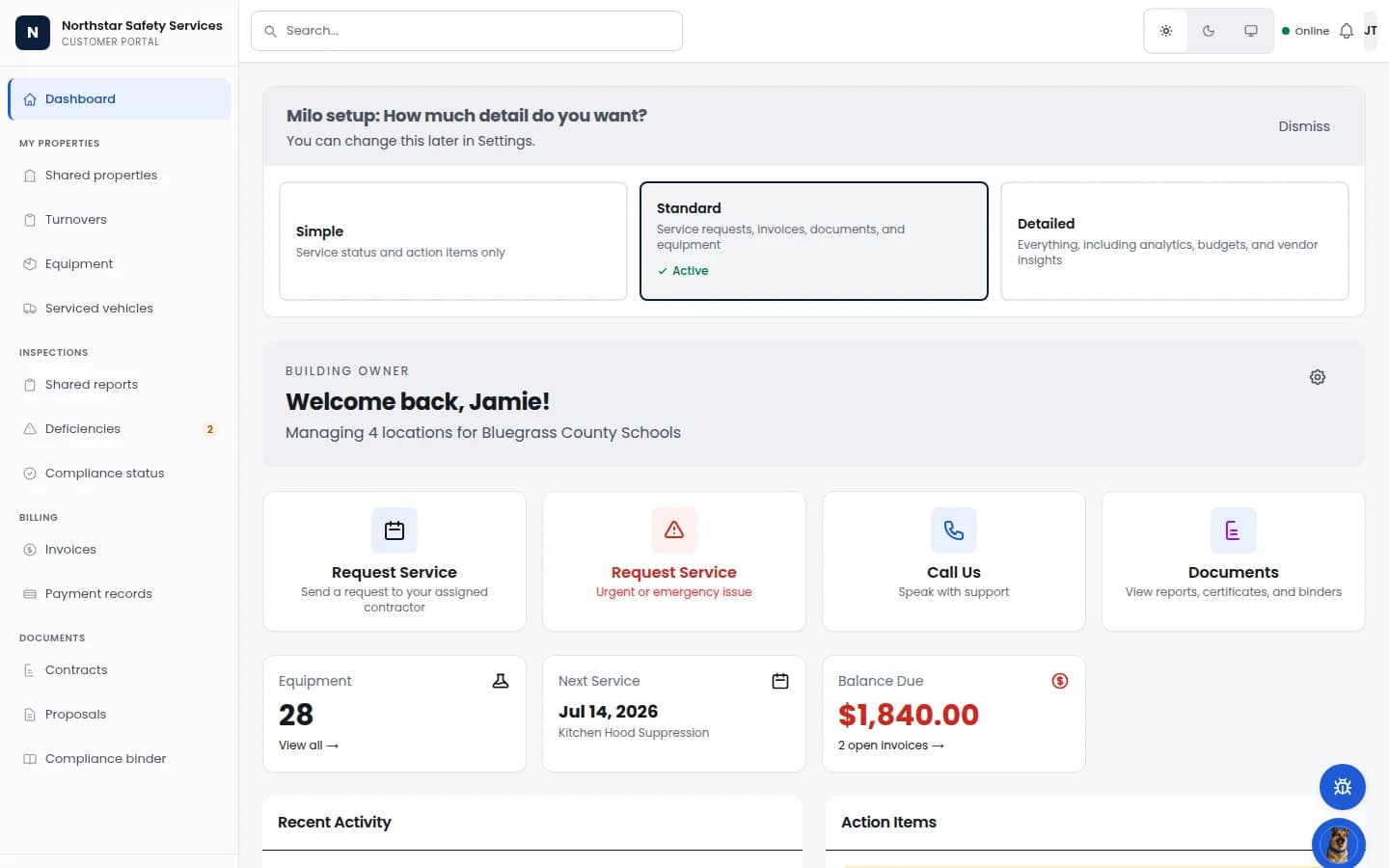
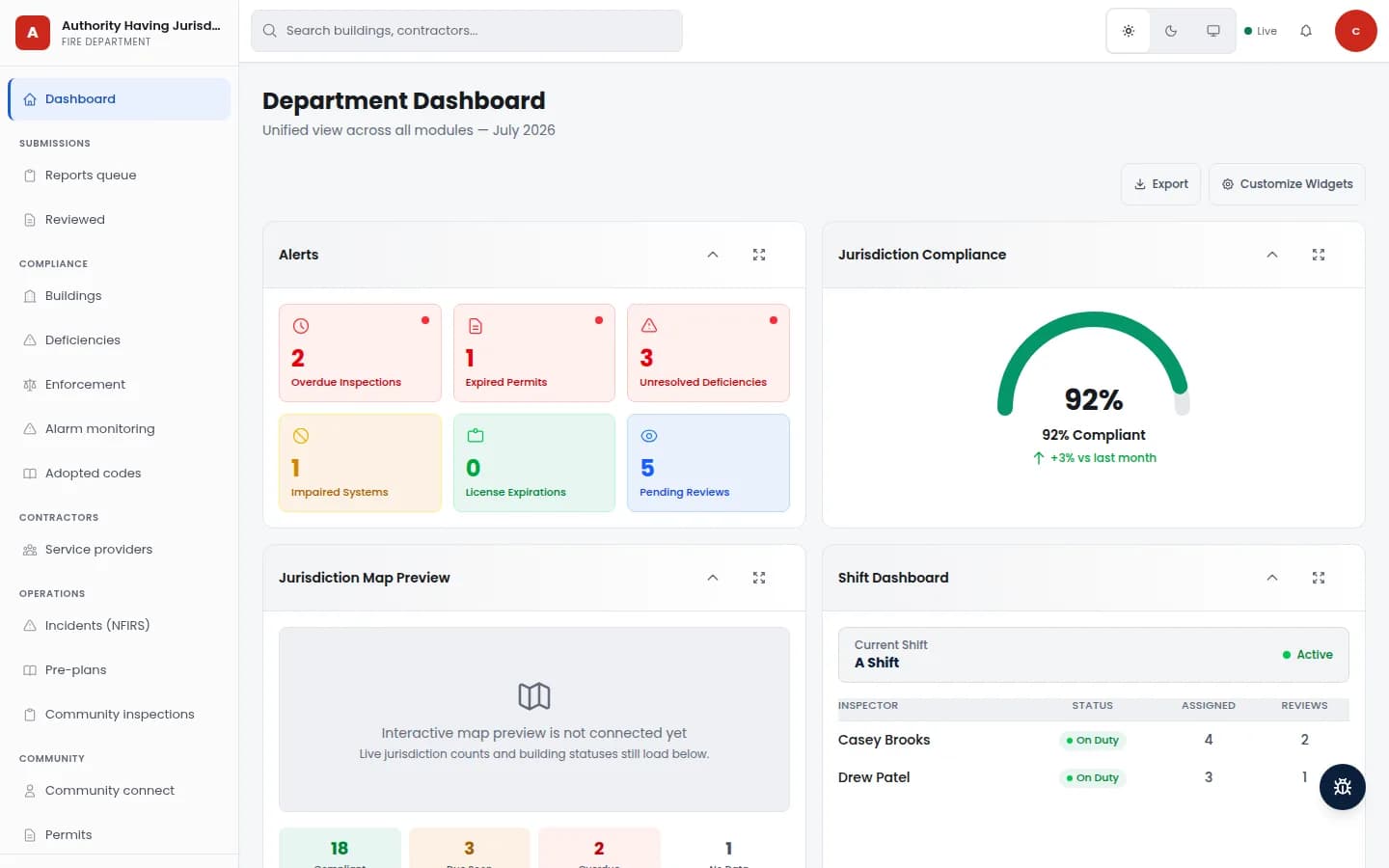
Customer and AHJ visibility
Scoped views for building owners and compliance reviewers.
Visibility surfaces for the people who need the right slice of the record.
Department software entitlement is separate from outside service costs.
Participating departments use supported inspection, compliance, records, permit, preplan, hydrant, community, document, communication, dashboard, export, and audit workflows under their written entitlement without per-user, module, or feature-activation software fees.
CAD and call-provider integrations, provider-specific connector work, bespoke conversions, extraordinary implementation, optional enhanced support, and approved third-party expenses remain separate. Activation gates remain mandatory even when software is included.
Third-party report filing supports department review, deficiency follow-through, and premises and system records. Filing fees are paid to Guspora for the filing service; they are not department revenue or a government fee.
Adoption alone does not create a required filing channel. A department controls activation through its signed policy, exact report rules, effective date, configuration, training, and operational acceptance.
Departments can evaluate Guspora as a Kentucky-built operations platform with contractor-side field experience.
Department software entitlement with separate integration and service scopes.
| Capability | Guspora | First Due | IROL/TCE | Lexipol Live Safe | Inspect Point |
|---|---|---|---|---|---|
| Department entitlement | Supported software by written entitlement | Per-department license | Per-department license | Subscription | Department-paid |
| Contractor-side workflow | Same canonical record | Separate | Separate | Separate | Contractor-side product |
| Internal AHJ inspection workflow | Where supported | Built in | Limited | Add-on | No |
| CAD / provider integrations | Separate written integration scope | Roadmap | Roadmap | Roadmap | No |
| Shift scheduling | Where supported and accepted | Built in | Limited | Add-on | No |
| Training workflows | Where supported and accepted | Add-on | Add-on | Built in | No |
| Incident command | Included software; safety requirements apply | Built in | Limited | Add-on | No |
| Pre-plan / premises visibility | Included where supported | Built in | Limited | Add-on | No |
| Hydrant management | Included where supported | Add-on | No | No | No |
| Direct contractor data feed | Native | Integration | Integration | Integration | Native (contractor side only) |
Detailed competitor comparisons live on the dedicated comparison pages. This table is the AHJ-side summary.
When the contractor and the AHJ are on the same record, the moat is the architecture.
Three parties participate in every regulated occupancy: the contractor who maintains the system, the building owner who pays for the work, and the AHJ who enforces the code. The Disclosure Domain in the Guspora core captures consent, scopes access per party, and audits every disclosure event.
When all three are on the platform, an inspection report is one record viewed through three lenses, not three separate copies that drift. Code violations propagate to the responsible contractor and the property owner the moment the AHJ writes them. Plan submittals collaborate live. Disclosure trails withstand audit.
Competitors integrate. Guspora unifies. That is a difference of architecture, not feature count.
Standard activation and acceptance testing do not convert supported departmental software into paid custom services.
CAD and call-provider integrations, provider-specific connector work, bespoke conversions, extraordinary implementation, optional enhanced support, and approved third-party expenses require a separate written scope. Every operational workflow remains disabled until its applicable security, configuration, training, records/privacy, accessibility, and acceptance gates pass.
For fire departments and AHJs
Review your department’s supported software entitlement and setup requirements.
Fire marshals, inspectors, and department administrators can review supported workflows, configuration, training, acceptance, records/privacy, accessibility, and any separately scoped integration or support needs.