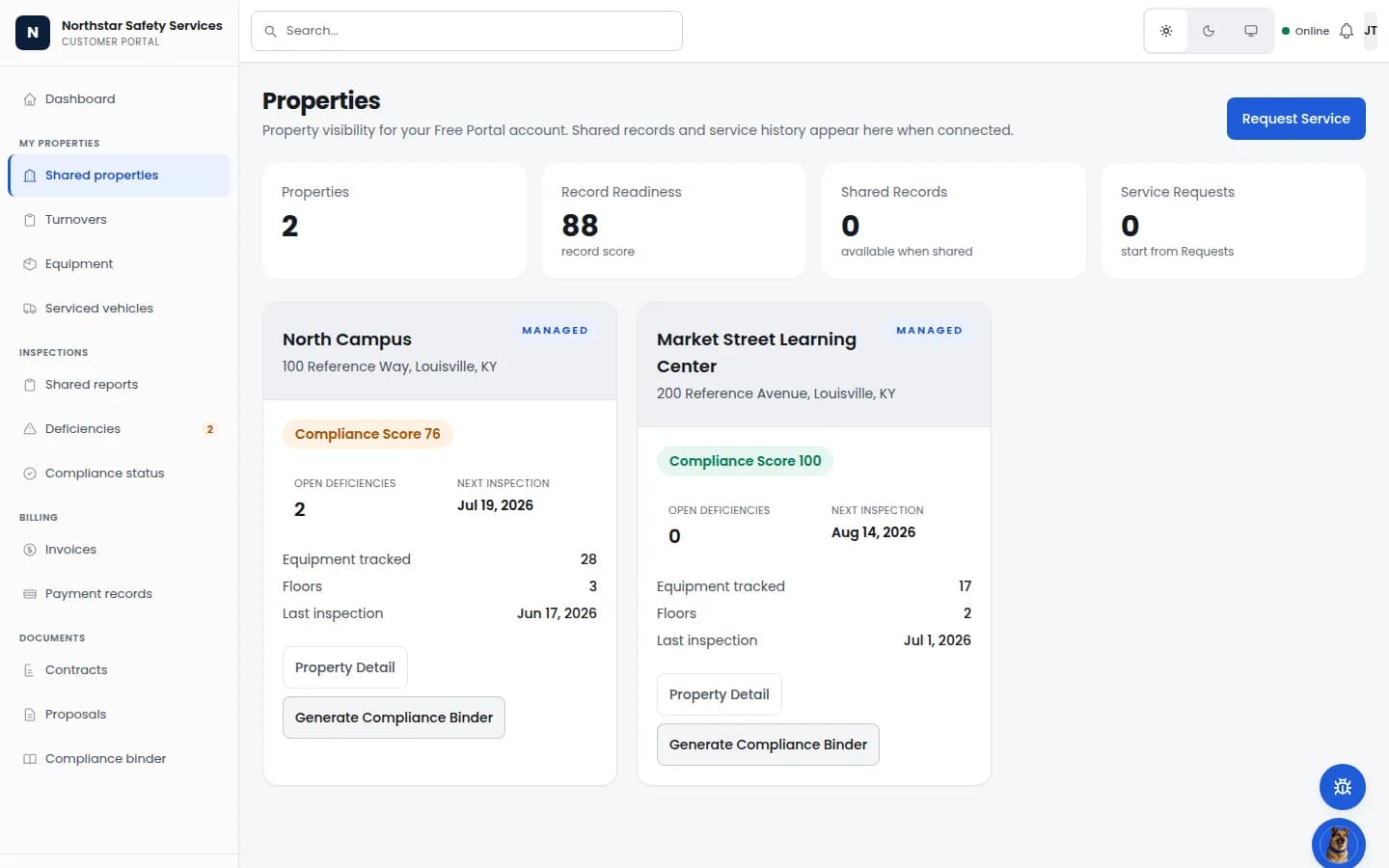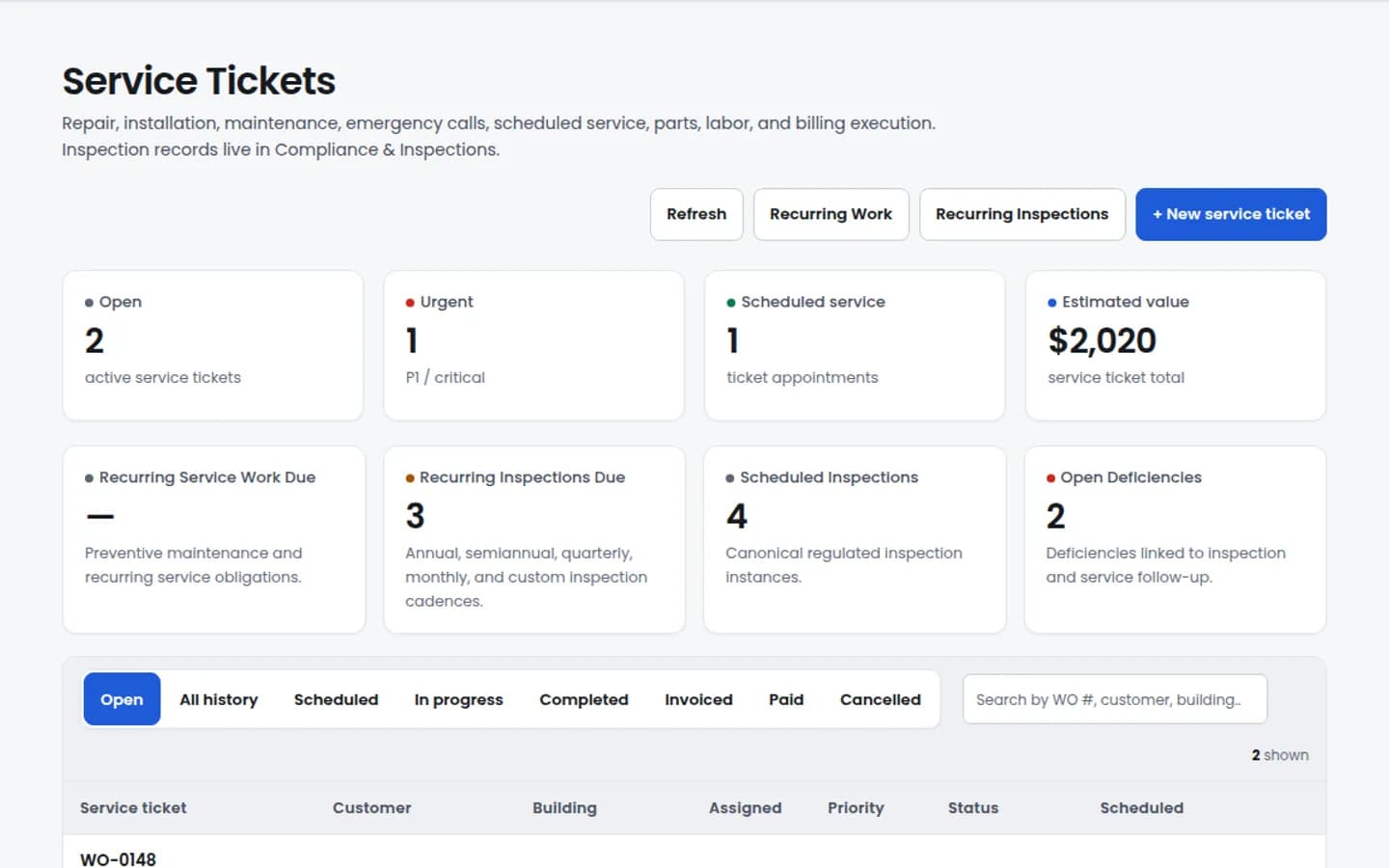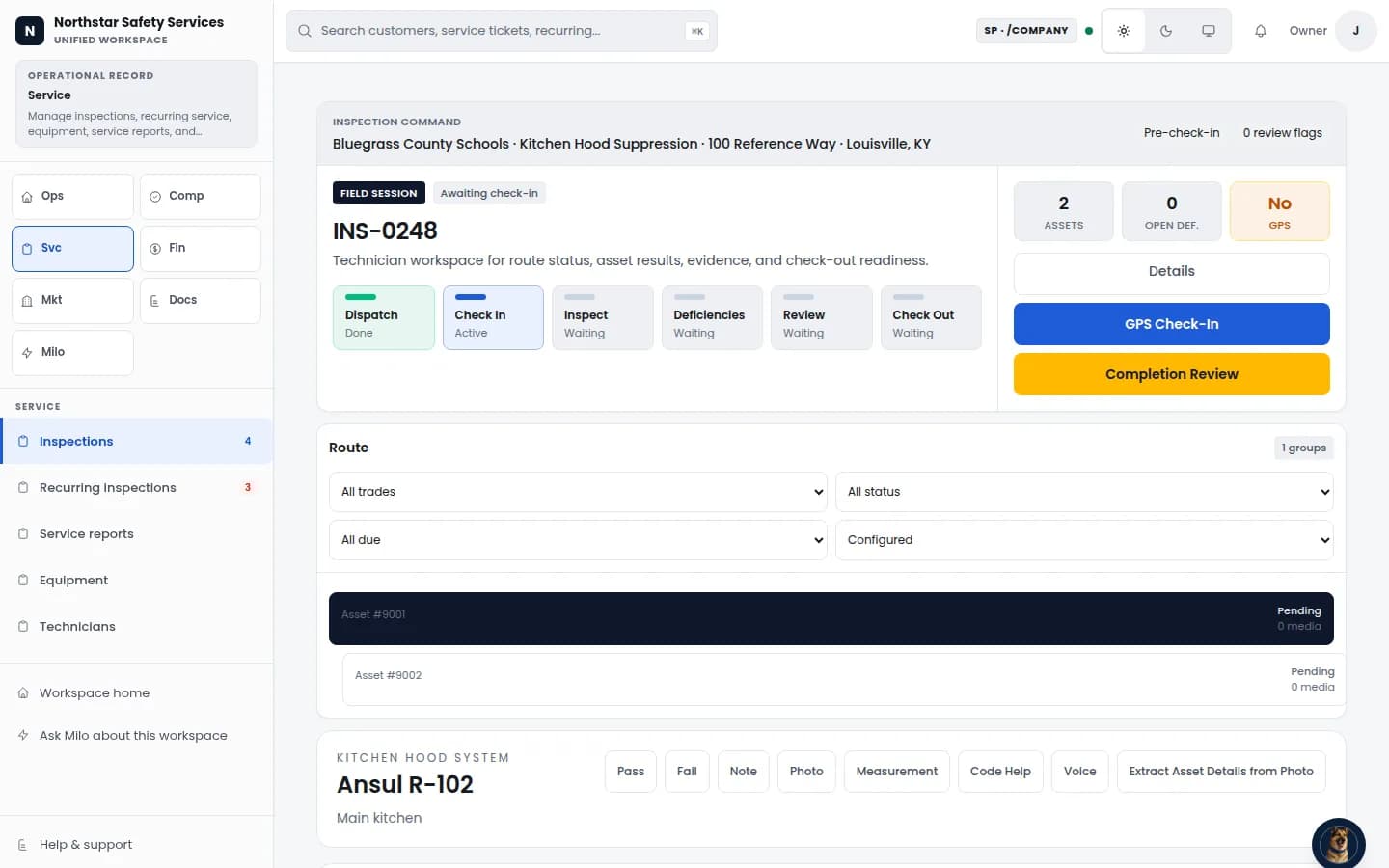
Suite — Free for fire departments

The AHJ workspace your department deserves. At no cost to your jurisdiction.

Inspections, violations, contractor submissions, community connect, permits, NFIRS submission (the federal incident-reporting standard, ready today), pre-plans, hydrants -- all on one record. Built with fire marshals, not for them. Funded by contractor subscriptions on the other side of the platform; donated to every fire department, period.

No card. No trial clock. No bait-and-switch on year two.

Who it’s for

The fire marshal, the inspector, and the chief — reading the same record.

  • For the Fire Marshal

    A jurisdiction-wide view that you can run a department off of. Pending re-inspections, open violations, contractor submissions awaiting your review, community profiles flagged as functional-needs, all on one screen. Quarterly board report exports without an analyst.

  • For the Inspector

    A clean queue on the tablet. Tap into a building and the pre-plan, last-inspection findings, equipment list, and contact info are already there. Capture photos, log violations, sign — the report is final before you leave the parking lot.

  • For the Chief

    You don’t have to fight a budget line item. The base workspace is funded by contractor subscriptions on the other side of the platform — your department gets it at no charge, with no trial clock and no year-two bait-and-switch.

What is in the suite

Eleven modules. One AHJ record.

The base workspace is free. Paid extensions exist for advanced features without changing the underlying record.

  • Premises & Occupancies

    Available now

    Jurisdictional inventory of premises, occupancy classes, responsible parties, and last-inspection state. The same record an inspector reads on the truck is the row an admin manages from the desk — no separate spreadsheet, no dual-data-entry pass.

  • Inspections

    Available now

    Annual, complaint-driven, and re-inspection schedules queue automatically. Findings cite the jurisdiction’s adopted NFPA edition (not whatever was published last). Photos and notes attach to the record, not to a phone’s camera roll.

  • Violations & Notices

    Available now

    Capture violations on the inspection. Generate notices with the right citations, abatement deadlines, and re-inspection targets. Re-inspection runs against the open items only — no re-walking the whole building.

  • Contractor Submissions

    Available now

    Licensed contractors submit fire-protection inspection reports directly. Free to submit if invited by your department. Public paid uploads (one-time, $24.99) auto-route to your queue based on jurisdiction. Three-attempt free resubmission window if a report is rejected — the contractor pays once, and you stay focused on review, not collecting.

  • Community Connect

    Available now

    Residents and businesses self-register property data — functional needs (mobility, oxygen, bedridden), hazards (pool, propane, solar, EV charger), pets, emergency contacts, access notes. Visible to your responders before the truck rolls. Consent-gated, with three data-sharing tiers.

  • Department Outreach (CRM + Campaigns)

    Available now

    Built-in email engine for keeping contractors and businesses in the jurisdiction current — annual inspection reminders, code-update bulletins, smoke-alarm program drives. Audience targeting, scheduling, send-and-track, no Mailchimp subscription required.

  • Permits

    Available now

    Operational, construction, and hot-work permits on the same spine as inspections. Application intake, fee calculation, approval routing, payments, analytics, and renewal reminders — all wired into the AHJ portal sidebar.

  • NFIRS submission

    Available now

    Guspora supports the federal NFIRS incident-reporting standard for fire departments. Native record schema across the standard NFIRS modules, pre-submission validation, per-jurisdiction state-authority routing, credentials configured in the AHJ settings UI, and full audit trail. Annual no-activity attestation supported for departments with quiet years.

  • Pre-Plans

    Available now

    Building pre-plans on the same record as the inspection — hydrants, hazmat, FACP and Knox-box notes, contact list, structural notes, scenarios, attachments, and a printable cab-ready view. Map overlay shared with mutual-aid partners by building.

  • Hydrants & Water Supply

    Available now

    Hydrant inventory with flow tests, condition, and last-service date. Geo-positioned for cab-visible map overlay. Linked to the pre-plan for the building it serves.

Public intake

Two public-facing intake paths. Both ride into your queue.

Most departments lose information at intake — a fax that didn’t come through, an email that landed in someone else’s inbox, a voicemail nobody returned. Guspora’s public intake is built so neither residents nor contractors need an account to give your department what it needs.

  • Resident self-registration

    • Public form at /community/<your-slug>. No account, no login.
    • Captures functional needs (7 types), hazards (pool, propane, solar, EV charger, generator), pets, emergency contacts, gate codes, lock-box info, access notes.
    • Consent-gated. Three data-sharing tiers: response-only (event-driven), full department, or public-safety (mutual aid). Resident controls the dial.
  • Public paid contractor uploads

    • A contractor not yet onboarded with your department can still submit a report. $24.99 one-time, paid by them.
    • Auto-routed to the AHJ assigned to the property’s ZIP. Lands in your normal review queue with the contractor’s license, photos, and inspection record.
    • If you reject the report, the contractor gets a free 30-day window with up to three resubmission attempts. After three, the submission goes terminal — no refund, no re-charge, no spam.
Department outreach

Reach the contractors and businesses in your jurisdiction without a Mailchimp account.

Annual inspection reminders. Code-update bulletins. Smoke-alarm program drives. Burn-permit-season notices. The Compliance Suite ships with a built-in CRM and email engine so your department can run an outreach program without wiring a separate marketing tool to your jurisdiction’s contact list.

  • Audience targeting on the actual record.

    Segment by occupancy class, last-inspection date, open-violation status, contractor license type, ZIP, or any field on the premises or contractor record. The list is the record.

  • Schedule, send, track.

    Compose, schedule, send. Open rates, response rates, bounce handling. Drip sequences for multi-step programs (annual reminder + 30-day follow-up + 60-day final notice).

  • No external subscription.

    Mailchimp, Constant Contact, HubSpot — none of them needed. The outreach engine is part of the free AHJ workspace.

A jurisdiction’s day, on Guspora

The whole department reading the same record.

  1. 1. Premises are real records, not a spreadsheet export.

    Every occupancy in the jurisdiction is a first-class row — responsible parties, occupancy class, last-inspection date, open violations. Inspectors read the same row admins manage.

  2. 2. The schedule queues itself.

    Annual cycles, complaint-driven inspections, and re-inspections all queue automatically. Findings cite the jurisdiction’s adopted NFPA edition. Photos attach to the inspection record, not a phone’s camera roll.

  3. 3. Violations get a notice, an abatement clock, and a paper trail.

    A violation captured on the inspection generates a notice with the right citations, the right deadline, and the right re-inspection target. Re-inspection runs against the open items only — not the whole building again.

  4. 4. Contractors submit reports without faxing them.

    A licensed inspection contractor working in the jurisdiction submits the report directly. The AHJ accepts, returns for revision, or asks for clarification. The contractor sees the status; you see the report. No email attachments lost in someone’s inbox.

  5. 5. Residents register their own property.

    Community Connect surfaces functional needs and hazards before the truck rolls. The resident controls what they share. Your responders see what they need to see.

  6. 6. Outreach runs from the same record.

    Annual inspection reminders, code-update bulletins, smoke-alarm program drives — segmented by occupancy class, last-inspection date, or any field on the record. No external Mailchimp account, no list export.

  7. 7. Permits, NFIRS submission, and pre-plans share the spine.

    Operational, construction, and hot-work permits run on the same record. NFIRS submission rides the same incident records into the state authority — credentials and routing configured per jurisdiction. Pre-plans on the same record as the building update as inspections happen, not on a separate cycle.

How it stacks up

Versus First Due, Vector Solutions, and ESO.

We’re not claiming we’ve replaced the incumbents at every depth. We’re claiming the base AHJ workspace gets your department off paper, off Excel, and off a $25,000-a-year contract.

CapabilityGusporaIncumbent tools
Full RMS for fire departmentsFree for every department. Funded by contractor subscriptions.First Due, Vector Solutions, ESO — typically $25,000+/year per department, multi-year contracts.
Permits and NFIRS submissionSame record as inspections. Permits live in the AHJ portal. NFIRS submission runs against state-authority endpoints configured per jurisdiction in the AHJ settings UI.Separate modules with separate logins. Many departments still use Excel for permits, and NFIRS support is generally a future-roadmap line item across the legacy vendors.
Pre-plans visible from the cabUpdated as inspections happen, on the same record as the building.A separate pre-plan tool that goes stale between annual inspection cycles.
Contractor inspection-report submissionDirect submission, three-party trust, public paid path with free resubmit chain.Email or fax. Paper. Or a separate "submission portal" the contractor has to license.
Community / resident registrationSelf-service form, consent-gated, functional-needs aware. Visible to responders.Smart911, CodeRED, or nothing. None ride on the same record as the inspection workspace.
Outreach to contractors and businessesBuilt-in email engine. Audience segmentation. Scheduling and tracking.A second Mailchimp account. List exports. Manual stitching.
Why free works

The contractors fund it. The departments use it. Both ride on the same record.

On the contractor side, Guspora is a paid platform — field service, dispatch, work orders, payments, the Business OS. Trade contractors who already need a system pay for it because it pays for itself in the first quarter. On the department side, the AHJ workspace is the same record from the inspector’s point of view. We don’t need to charge departments to keep the lights on.

The result: a department gets the same quality RMS that incumbents charge $25,000 a year for, plus a contractor submission queue, plus public intake (residents and paid uploads), plus outreach — for free. The only thing the department pays for is paid extensions, and only if you want them.

What "free" means here

  • No per-seat pricing on the AHJ workspace.
  • No trial clock, no year-two repricing.
  • No card on file, no procurement RFP cycle to start using it.
  • Departments can stop at any time and export their record.

What paid extensions look like

  • Multi-jurisdiction federation for regional bureaus or county-wide programs.
  • Advanced analytics — trends, ROI, board-ready reports.
  • Scoped programs (EMS, ePCR, MIH, hazmat, investigations) — preserved scaffolding, on-demand.
  • Implementation services for departments that want a hand on the rollout.
A note on dormant features

46 AHJ pages preserved. Not part of the free workspace today.

EMS, ePCR, MIH, incident command, hazmat, investigations, mutual aid, training/personnel/schedule overlaps — 23 feature subtrees, 46 pages — are intentionally unwired and preserved for post-JCFIA re-engagement (target: March 2028) or as paid Compliance extensions for departments that need them now.

We don’t market features as available when they’re not. If a module says "in progress," it’s in progress. If it says "available," it’s available today, in production, and your department can use it.

Common questions

The questions every department asks first.

  • Is the AHJ workspace really free?

    Yes. The base AHJ workspace is free for every fire department, period — no card, no trial clock, no year-two repricing. The platform is funded by contractor subscriptions on the other side. Paid extensions exist for advanced features (multi-jurisdiction federation, advanced analytics, scoped programs) and are optional.

  • How do residents register?

    A public page at /community/<your-department-slug>. No login. The form captures functional needs, hazards, pets, emergency contacts, and access notes, all consent-gated. Three data-sharing tiers let the resident control how widely the data is visible.

  • What happens if we reject a paid contractor submission?

    The contractor gets a 30-day window and up to three resubmission attempts at no additional cost. After three, the submission goes terminal — no refund, no re-charge. The platform delivered the document; AHJ acceptance is between you and the contractor.

  • Can we email contractors and businesses in our jurisdiction?

    Yes. The Department Outreach module is a built-in CRM + email engine — segment your contact list, schedule a campaign, send, track opens and replies. No external Mailchimp subscription needed. Use it for inspection reminders, code-update bulletins, smoke-alarm program drives, or anything else.

  • Are permits and NFIRS submission production-ready?

    Yes. NFIRS submission is wired into the AHJ portal — native record schema across the standard NFIRS modules, pre-submission validation, per-jurisdiction state-authority routing, FDID and submitting-officer configured in the AHJ settings UI, and a full per-attempt audit trail. Permits are live in the AHJ portal — full CRUD, QA review workflow, and state-submission record fields.

  • Does it integrate with our CAD?

    Yes. CAD inbound webhooks are wired with HMAC signature verification per integration. We require a shared secret before any production CAD writes; the demo path runs against the [DEMO] Bardstown jurisdiction (id 404) for proof-of-flow.

  • Why are 46 AHJ pages "dormant" in your codebase?

    EMS, ePCR, MIH, incident command, hazmat, investigations, mutual aid, hydrants/training/pre-plans/personnel/schedule overlaps, and 23 feature subtrees in total are intentionally unwired and preserved for post-JCFIA re-engagement (target: March 2028) or as paid Compliance extensions. They are not part of the free workspace today, and we don’t market them as available.

  • How do we get started?

    Register your department at /ahj/register or talk to us. We’ll set up your jurisdiction record, walk through onboarding, and import any existing premises list you have today.

Ready to put your department on Guspora?

The base AHJ workspace is free for every fire department. No card. No trial clock. No bait-and-switch on year two.

Looking for the public inspection-requirement checker? Open the checker.